When you purchase through links on our land site , we may earn an affiliate charge . Here ’s how it make for .
A picture gallery of strikingochrepaintings make onto monolithic rock faces offers insight into the close human relationship between humans and animals exist in the Amazon 1000 of days ago .
The artwork is place on rocky outcroppings at Cerro Azul in Serranía de la Lindosa , a cliff in Colombia . It boast 3,223 drawings of human being and animals , including a zoo of Pisces the Fishes , reptile and mammalian of various size , according to a novel study in the September issue of theJournal of Anthropological Archaeology .
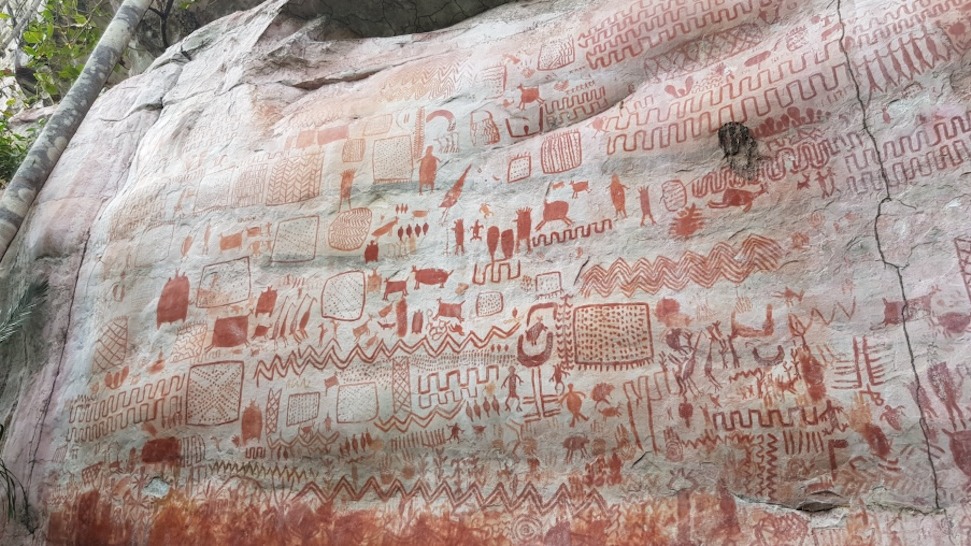
The gallery of rock art is the earliest evidence of humans living in western Amazonia.
Some of the imagery even render animals and humans morphing into each other , point " the rich mythology that guide generations of autochthonic Amazonians , " according to a statement from theUniversity of Exeter .
Although the researchers have not formally dated the canvas of artwork , they forecast that it has been around since 10500 B.C.
" These John Rock nontextual matter sites include the earliest evidence of world in western Amazonia , dating back 12,500 class , " lead authorMark Robinson , an associate professor in the Department of Archaeology and History at the University of Exeter , tell in the statement .

The rock art contains an array of subject matter, including (a) fishing; (b, c, e) hunting; (d) a monkey leaping; and (f) an unknown animal with circular feat and curved head elements.
Related:9,000 - twelvemonth - honest-to-goodness rock artistry discovered among dinosaur footprints in Brazil
The squad found at least 22 mintage of creature , including cervid , birds , musk hog , lizards , turtles and tapir . After compare the animal drawing off with ancient butchered fauna ivory found in nearby excavation , the archaeologists bump that the proportional representation of drawings by species did not gibe the symmetry of animal bones , point that the autochthonal people did n’t just paint what they ate . The butcher finger cymbals included a diverse dieting , including fish , mammals and reptiles , such as snakes and crocodiles .
" The art is an awesome sixth sense into how these first settler understood their position in the globe and how they formed relationship with animals , " Robinson say . " The context evidence the complexness of Amazonian relationships with brute , both as a food root but also as revered beings , which had supernatural connections and demanded complex talks from ritual specialiser . "

Because the rock artwork is so extensive , the researchers opted to focus on six gore , admit the 131 - foot - foresighted ( 40 meters ) El Más Largo , which contains 1,000 drawing , and the much minor 33 - understructure - long ( 10 m ) dialog box known as Principal , which contain 244 image , according to the program line .
— terrible drought reveals more than 100 sway sculpture in Amazonian affluent that may be up to 2,000 years sometime
— 3,500 - year - old rock art of wild sheep and double - hunchbacked camels revealed in Kazakhstan

— Ancient rock art in Argentine cave may have air entropy across 100 generations
After cataloging the nontextual matter , researchers found that 58 % of the drawings were figurative , of which one-half were images of animate being . They also noticed scenes depicting citizenry fish .
investigator can only speculate about the purpose and import of the rock and roll art .

" Though we can not be sure what meaning these images have , they certainly do tender cracking nuance to our understanding of the power of myths in autochthonic communities , " study co - authorJosé Iriarte , a prof of archaeology at the University of Exeter , said in the statement . " They are particularly revealing when it comes to more cosmological vista of Amazonian life , such as what is deal tabu , where power lodge in , and how negotiations with the supernatural were conduct . "


